3 Things CX Professionals Can Learn from NYC311
New York City’s public service hotline has excelled in unifying contact channels, allowing New Yorkers to choose how they want to resolve various non-emergency issues.
Add bookmark

"311 Day" might be behind us on March 11th, but we still have a lot to learn from New York City's consolidation of city services into one hotline. Going back to 1996, in Baltimore, the city non-emergency line was born out of a need to unify city services and allow residents to access them promptly without using resources allocated for 911. We might take the idea of consolidating these services into one number for granted, but New York City used to have fourteen phone book pages representing over 200 non-emergent city departments. Fast forward to March 2003– NYC implemented consolidated non-emergency services into one number, 311, and it's since become the largest system in the world, having taken over half a billion inquiries through 2023.
Today, residents can use NYC311 24 hours a day, 7 days a week, and be routed exactly where they need to go. To give perspective on the flow of channels NYC 311 service offers, 28% of customer inquiries were made through portal.311.nyc.gov, 3% through the NYC311 app, and 1% through other channels like social media. The remaining majority, however, were over the phone.
NYC311 can be used to report any issue that's not emergent, such as illegal parking, building issues, lack of sufficient heat or hot water, graffiti, and much more. The website, app, social media, and contact centers can be consulted for parking updates, collections schedules, and school closure information. Residents can also access other government services, such as food stamp information, affordable housing access, and parking ticket payments.
To run this operation, New York State established a customer experience office in 2023. Tonya Webster heads the office, as the first Governor-appointed Chief Customer Experience Officer in the country. New York's prioritization of its residents' safety and well-being is evidenced by Governor Hochul's appointment of Webster, and treating residents as customers in a metropolis built on commerce feels very apt. Tonya Webster has over twenty years of executive experience leading CX in the public and private sector, and showing residents that their experience living in New York City is valued helps these constituents better contribute to their communities.
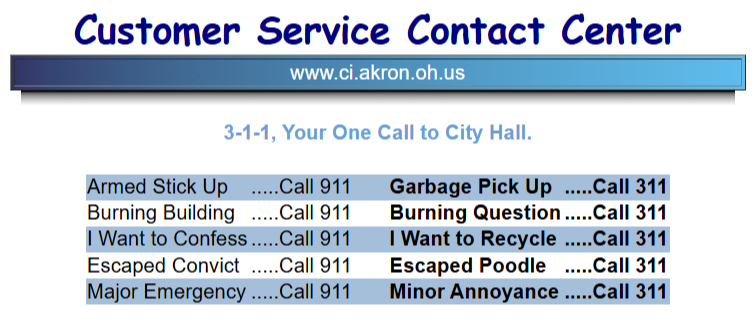
A screenshot promoting 311 in Akron, OH showing uses for 911 versus 311.
What Can Contact Center Professionals Learn from NYC311?
1. Omnichannel support is paramount
NYC311 meets its customers where they are, whether that's social media, phone, text, or website. Unifying these channels and creating consistent experiences through all allows customers to trust that they're getting the best customer service experience regardless of how they want support. Often, these issues are critical– not just a shipping delay or return question, but a blocked driveway or rodent problem. The ability to choose the channel that works for a resident can make 311 more accessible during urgent issues that still don't warrant a 911 call.
2. Consistent customer feedback loops are crucial– but not as important as the decisions made based on that data
Utilizing satisfaction surveys sent to every resident who requests support, NYC311 publishes and uses that data to improve its customer experience as well as tailor agent schedules based on queue volume. Service is constantly being refined, and the mayor's office is using feedback submitted through 311 in order to prioritize resident concerns. For example, Mayor Mamdani's attention to potholes, the second highest reported complaint after housing maintenance, has resulted in over 100,000 filled within his first 100 days in office. This attention to the data provided by NYC311 is allowing city officials to make change that matters.
3. Efficient call routing lends itself to seamless agent and customer experiences
Routing customers to the correct department, though there are a plethora of them, is essential to reducing wait times and escalations. 68% of NYC311 inquiries were over the phone, and operations' organizational design allows for efficiency as a customer is being directed to one of the over 200 city departments. Wait times remain under 30 seconds, which is a feat for a population of over 8 million.
Contact centers, even ones in the private sector, have much to learn from New York City's 311 approach. Publishing data for its community to see is a transparent move which encourages trust in the city and its agents. 311 in NYC has excelled in omnichannel, where a customer knows what they're getting despite the method of contact. Constantly learning from its residents by asking about if or how the issue was resolved allows for quick changes and spotlights on more serious problems. Within the contact center realm, operations teams can design their routing of calls to reduce wait times and get a customer the right kind of help they need, almost immediately.
Image credit to Daniel Höhe via Unsplash.